

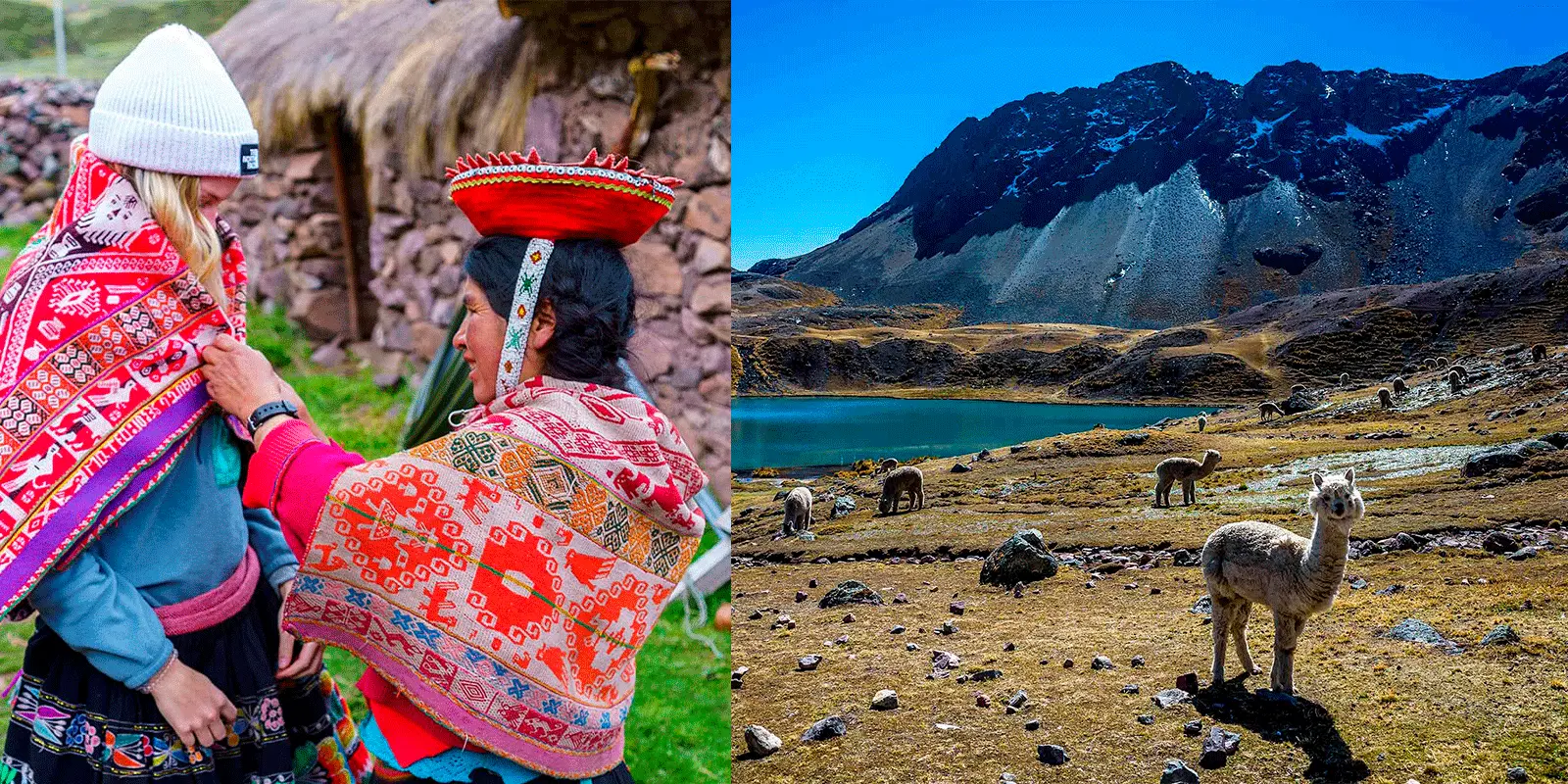
Choosing the ideal hiking route in the Peruvian Andes, in Cusco, is one of the decisions that can be difficult when planning a trip. If you are hesitating between the Lares Trek and the Ausangate Trek, you should know that both are spectacular routes that take you away from the crowds, but offer completely different experiences and logistics.
To help you make the best decision, we break down the key differences, the landscapes you’ll see, and how each route connects to the crown jewel: Machu Picchu.
Lares Trek: cultural immersion and direct route to Machu Picchu
Often referred to as “the cultural route,” the Lares Valley basin takes you through traditional Andean communities where time seems to have stood still. It is famous for its colorful weavers, hot springs, and glacial lagoons.
Logistics and Machu Picchu
The great advantage of the Lares Trek is its smooth logistics to the Inca citadel. This route strategically ends in the Sacred Valley (usually in Ollantaytambo), making it easy to take the train directly to Aguas Calientes (Machu Picchu Pueblo).
- Duration: There are 2-, 4-, and 5-day itineraries.
- Connection to Machu Picchu: Direct. The last day of the trek puts you in the perfect position to visit this wonder of the world.
The perfect combination: For the more adventurous, the Lares Trail can be combined in an incredible way with the Short Inca Trail. This means that after exploring the landscapes of Lares, you can enter Machu Picchu on foot through the iconic Inti Punku (Sun Gate), achieving a truly complete experience.
Ausangate Trek: Wild Nature and High Mountains
If you are looking for vastness, solitude, and to challenge your physical limits, Ausangate is for you. This route circles the highest snow-capped mountain in the Cusco region (Apu Ausangate) and takes you into a world of imposing glaciers, turquoise and red lagoons, and herds of alpacas and llamas in their natural habitat.
Logistics and Machu Picchu
Unlike Lares, the Ausangate circuit is located in the Vilcanota mountain range, southeast of Cusco, which is completely different.
- Duration: This is a very versatile route, with options of 1, 2, 3, 4, 5, and even 6 days to complete the entire circuit around the massif.
Connection with Machu Picchu: A return trip is required. As it is in a different geographical direction, to get to Machu Picchu you first have to return to the city of Cusco at the end of the trek. From there, you will have to start a new journey (by train or mixed transport) to Aguas Calientes.
Highlights: The possibility of including the famous Rainbow Mountain (Vinicunca) or Palccoyo in the itinerary, far from the crowds of traditional tours.
